




Women’s health in Kenya is undergoing a significant transformation. While maternal care and infectious diseases have traditionally dominated healthcare conversations, the latest healthcare claims data reveals a different reality. Chronic diseases, mental health conditions, and preventive care are becoming increasingly important, reshaping how healthcare providers, insurers, employers, and policymakers should design healthcare services.
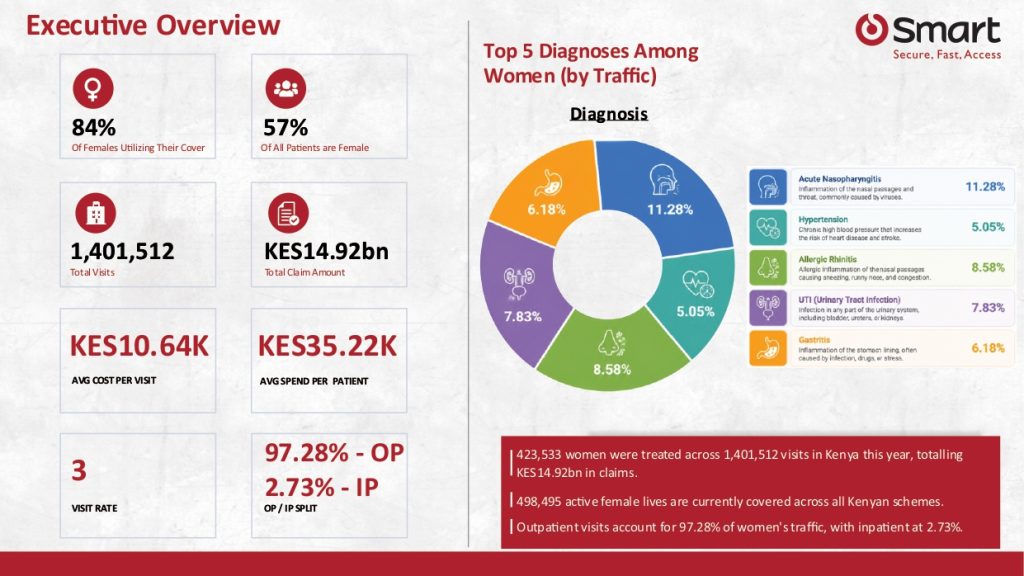
In just six months, 423,533 women made 1.4 million healthcare visits, generating KES14.92 billion in healthcare claims. These figures provide valuable insights into women’s healthcare utilisation in Kenya, highlighting emerging disease patterns and the need for healthcare systems to evolve.
Women’s Healthcare Utilisation in Kenya Is Growing
Women are actively using healthcare services more than ever before. They account for 57% of all patients, with insured women averaging approximately three healthcare visits each year.
The vast majority of these interactions occur through outpatient healthcare services (97.28%), indicating that women are increasingly seeking routine consultations, preventive care, chronic disease management, and early medical intervention rather than waiting until illnesses require hospitalisation.
This high level of healthcare utilisation demonstrates that women are engaging with their health benefits. The challenge is no longer encouraging healthcare access but ensuring that healthcare systems and benefit designs reflect today’s healthcare realities.
Chronic Diseases Are Reshaping Women’s Health in Kenya
One of the most significant healthcare trends emerging from the claims data is the growing burden of non-communicable diseases (NCDs) among women.
Hypertension Has Become the Leading Chronic Disease
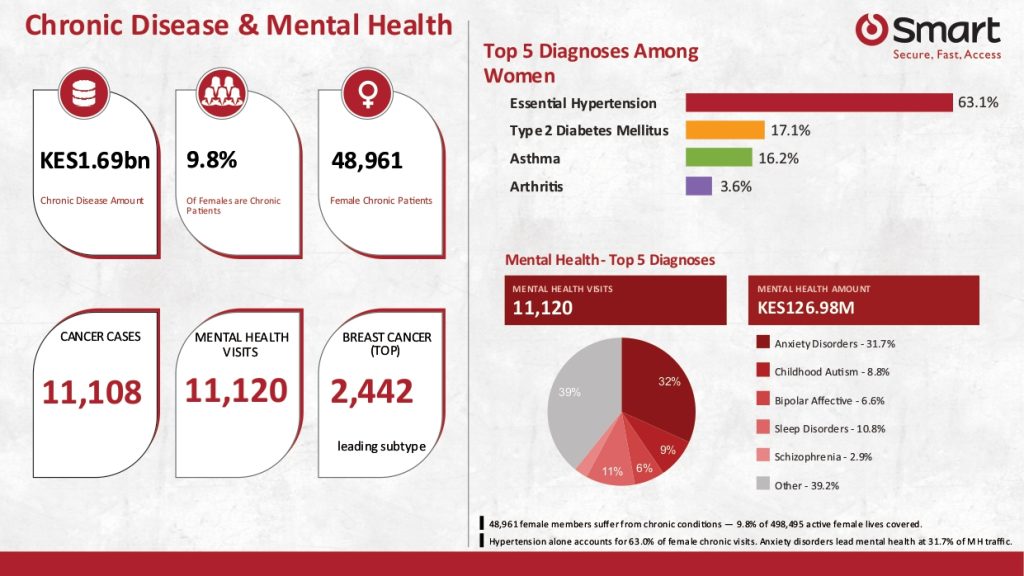
Hypertension now accounts for 63.1% of all chronic disease visits among women, making it the leading chronic health condition. It exceeds diabetes by more than three times and asthma by nearly four times.
During the reporting period, hypertension affected 48,961 women and generated KES1.69 billion in healthcare claims, making it one of the most significant drivers of healthcare expenditure.
The findings reflect Kenya’s ongoing epidemiological transition, where chronic diseases are replacing infectious diseases as the leading cause of long-term healthcare utilisation.
Mental Health Is Becoming a Healthcare Priority
The data also highlights the growing importance of mental health services in Kenya.
Women recorded 11,120 mental health-related visits, amounting to KES126.98 million in healthcare claims. Anxiety disorders represented nearly one-third of these consultations, demonstrating that mental health has become an essential component of women’s healthcare rather than a secondary concern.
As healthcare demand evolves, integrating mental health support into employee health benefits and insurance schemes will become increasingly important.
Breast Cancer Continues to Drive Healthcare Costs
Cancer remains another major healthcare priority.
The claims data recorded 11,108 cancer cases, with breast cancer emerging as the most common cancer among women, accounting for 2,442 visits and KES75.83 million in claims.
These findings reinforce the importance of regular breast cancer screening, early diagnosis, and timely treatment to improve patient outcomes while reducing long-term healthcare costs.
Maternal Healthcare Remains Strong, But New Challenges Are Emerging
Maternal healthcare continues to demonstrate encouraging levels of engagement.
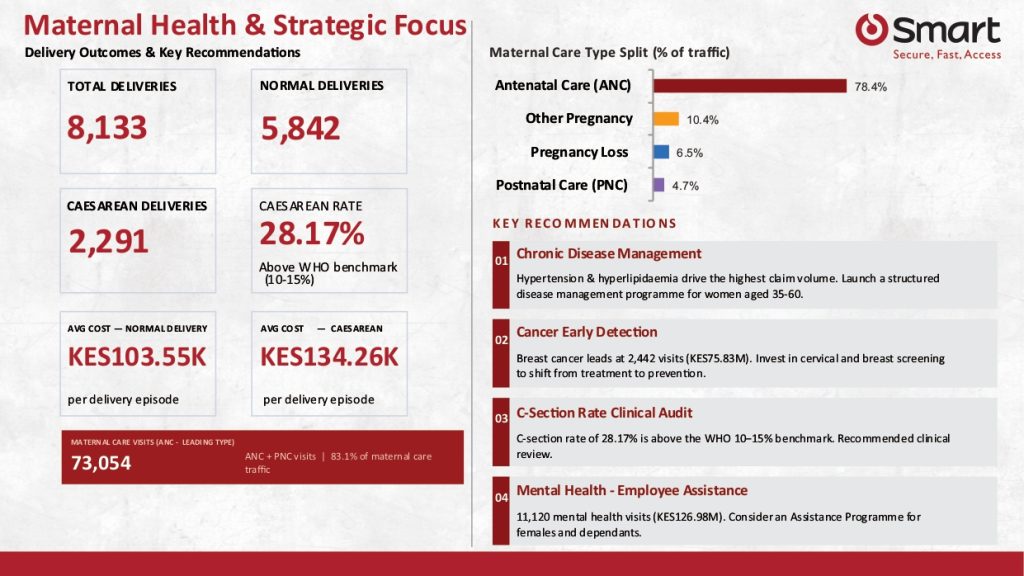
Antenatal care accounts for 78.4% of maternal healthcare visits, while antenatal and postnatal care together represent 83.1% of maternal healthcare utilization. This reflects strong participation in pregnancy-related healthcare services and continued investment in maternal wellbeing.
However, the data also identifies emerging areas requiring closer attention.
Pregnancy Loss Requires Further Investigation
Pregnancy loss accounts for 6.5% of maternal healthcare visits, highlighting the need for additional clinical research and targeted interventions to better understand the underlying causes and improve maternal health outcomes.
Caesarean Section Rates Exceed Global Recommendations
The claims data also shows that 28.17% of deliveries were performed through Caesarean section, nearly double the World Health Organization’s World Health Organization recommended upper benchmark of 15%.
Beyond the clinical implications, Caesarean deliveries have a significant financial impact. The average Caesarean costs approximately KES134,000, compared to KES103,000 for a normal delivery, increasing healthcare expenditure across thousands of births annually.
These findings support the need for ongoing clinical audits and evidence-based maternity care practices.
What These Women’s Health Trends Mean for Kenya’s Healthcare System
The latest women’s healthcare data in Kenya provides more than statistics; it offers a roadmap for healthcare transformation.
Healthcare providers, insurers, employers, and policymakers have an opportunity to strengthen healthcare delivery by:
- Expanding chronic disease management programmes, particularly for hypertension.
- Increasing investment in breast cancer screening and early detection.
- Integrating mental health services into standard healthcare benefits.
- Strengthening maternal healthcare through continuous monitoring and clinical quality improvement.
- Designing healthcare benefits that better reflect modern patterns of healthcare utilisation.
Women already represent 57% of healthcare users, while 84% of insured women actively utilise their healthcare benefits. They are not waiting to engage with the healthcare system; they are already doing so.
The next step is ensuring that healthcare systems evolve alongside their changing needs.
As women’s health in Kenya continues to shift toward chronic disease management, preventive care, and integrated healthcare services, organisations that adapt their healthcare strategies today will be better positioned to improve health outcomes while creating more sustainable healthcare systems for the future.